
VIP member
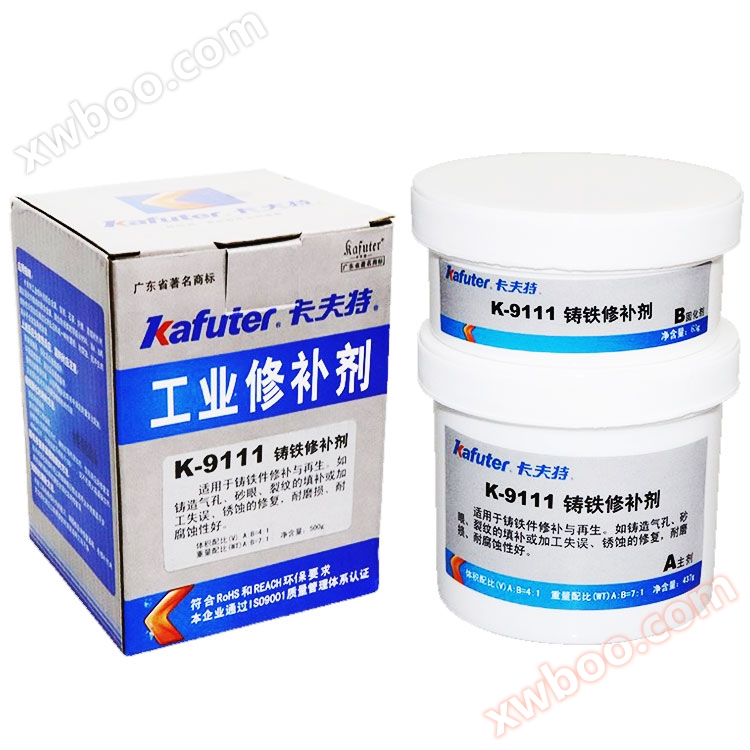
Kraft K-9111 Iron Repair Agent Cast Iron Repair Agent K-9111 Repair Agent
Brand: Kraft Model: K-9111 Adhesive Material Type: Metal Industrial Repair Agent Series: It is a polymer metal composite repair material with metal an
Product details
Brand: Kraft Model: K-9111
Adhesive material type: metal
Industrial repair agent series:It is a polymer metal composite repair material made of metals and alloys as bone materials, used to repair and seal defects such as sand holes, pores, and cracks in various metal castings, repair worn equipment parts, and seal and repair equipment under high temperature conditions. Characteristics: Wear resistance, corrosion resistance, high bonding strength with metal, easy construction operation, color can be maintained basically the same as the repaired one after repair, no shrinkage after curing, high strength, and can be used for various machining such as grinding and drilling.
K-9111Iron repair agentTwo component, adhesive like, with good comprehensive mechanical properties, suitable for repairing and regenerating ductile iron, gray cast iron, etc., such as filling sand holes, pores, cracks or repairing machining errors in castings, with good wear resistance and corrosion resistance.
K-9110 casting defect repair agent
K-9113 aluminum repair agent
K-9114 copper repair agent
Instructions for using industrial repair agents:
1. The adhesive bonding area should remove surface "loose substances" (free substances, rust, and surface contaminants, including the original coating). Sandblasting, electric grinding wheel, wire brush or coarse sandpaper can be used for polishing, which can remove dirt and roughen the surface to be repaired to improve the roughness of the repaired surface. Sandblasting is an excellent surface treatment method, especially suitable for the treatment of complex equipment structures. The sand material used for sandblasting should be sharp edged abrasives. If using an angle grinder, be particularly careful not to grind the surface to be repaired too smooth. The rougher the surface, the better. Finally, use acetone cleaning agent to wipe it off.
2. Industrial repair agents are composed of two components, A and B. If one package is not used up at once, the main agent A and curing agent B should be thoroughly mixed according to the specified mix ratio until the color is uniform and consistent, and used up within the specified operable time. It is recommended to use a balance with a weight ratio and an accuracy of 1g as a weighing tool. Sometimes it is inconvenient to weigh on site during construction. It is possible to visually determine the volume ratio for preparation, but it is better to use measuring cups and spoons to obtain materials as accurately as possible.
3. Apply the mixed repair agent onto the surface of the treated substrate, applying even force and repeatedly pressing to ensure full contact between the material and the substrate surface, in order to achieve optimal results. When multiple layers of adhesive are required, the original adhesive surface should be treated before application.
1. Do not touch the cleaned surface with your hands to prevent stains from contaminating the surface.
2. No liquid shall enter the surface to be repaired during the repair process.
3. Attention during summer construction: When the ambient temperature exceeds 35 ℃, it is not advisable to mix too much glue each time, and the glue should be quickly applied after mixing.
4. During the preparation process, sometimes air may mix into the repair agent and produce bubbles. You can use a glue knife to spread out the repair agent on a plastic board and slow down the stirring speed to release the bubbles.
K-9111 Iron Repair Agent
K-9112 steel repair agent
K-9215 wear-resistant repair agent
K-9737 high-temperature resistant repair agent
K-9121 micro seam repair agent
K-9406 corrosion-resistant repair agent.
Main physical and mechanical properties of the product
Product Model
color
Density (g/cm)3)
Compressive strength (MPa) GB/T1041-1992
Tensile strength (MPa) GB/T6329-1996
Shear strength (MPa) GB/T7124-1999
Bending strength (MPa) GB/T1024-1992
Hardness after curing (Shore D) GB/T2411-1980
Working temperature (℃)
K-9110 casting defect repair agent
grey
1.63
87.6
27.5
20.5
51
80
-60~120
K-9111 Iron Repair Agent
Grey iron color
1.62
88.0
30.5
23.4
55.6
82
-60~150
K-9112 steel repair agent
steel gray
1.70
95.8
38
24.2
57
89
-60~180
K-9113 Aluminum Repair Agent
aluminum color
1.52
94.8
32.5
19.8
52
87
-60~160
K-9114 Copper Repair Agent
brass
1.58
92.6
36.5
24.2
51.5
88
-60~170
K-9215 wear-resistant repair agent
black
1.83
168.5
57.6
26.5
85
94
-60~168
K-9121
green
1.08
108
-
12
-
-
-60~ 150
Precautions for using industrial repair agents:
Online inquiry
-
Contacts
-
Company
-
Telephone
-
Email
-
WeChat
-
Verification Code
-
Message Content
-