
VIP member
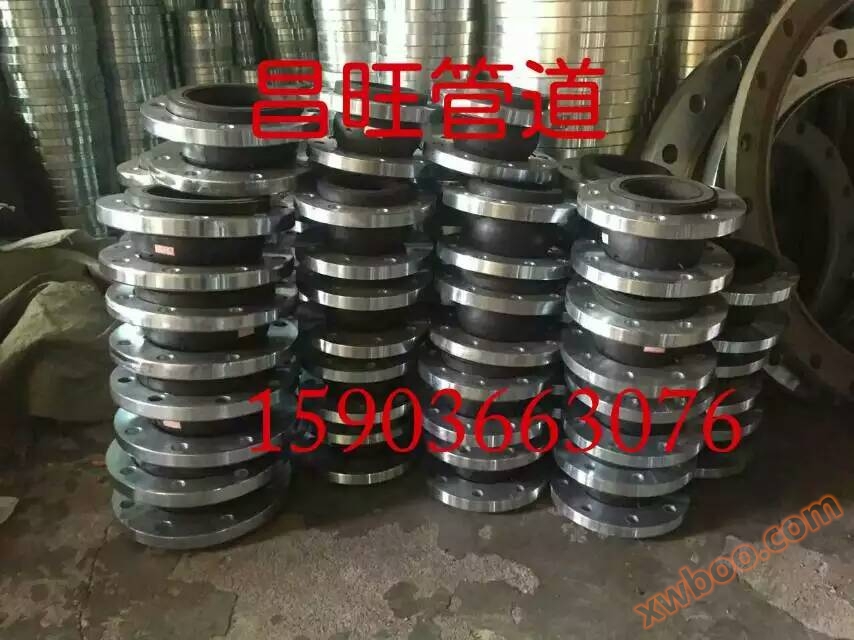
Rubber flexible joint
Rubber flexible joint is a joint composed of fabric reinforced rubber parts and flat flexible joints, loose metal flanges or threaded pipe flanges, us
Product details
Rubber flexible joint is a joint composed of fabric reinforced rubber parts and flat flexible joints, loose metal flanges or threaded pipe flanges, used for pipeline vibration isolation, noise reduction, and displacement compensation. It is a pipeline joint with high elasticity, high airtightness, medium resistance, and weather resistance. Divided by appearance: concentric equal diameter, concentric reducing diameter, eccentric reducing diameter. Divided by structure: single sphere, double sphere, and curved sphere. Divided by connection form: flange connection, threaded connection, threaded pipe flange connection. According to working pressure, there are five levels: 0.25MPa, 0.6MPa, 1.0MPa, 1.6MPa, and 2.5MPa.
Performance Characteristics
1. Small size, light weight, good elasticity, and easy installation and maintenance.
2. During installation, lateral, axial, and angular displacement can be generated, without being limited by pipeline misalignment or flange non parallelism.
3. It can reduce structural transmission noise and has strong vibration absorption ability during work.
Scope of application:
Due to its excellent comprehensive performance, rubber flexible joints are widely used in basic engineering such as chemical, construction, water supply, drainage, petroleum, light and heavy industries, refrigeration, sanitation, plumbing, fire protection, and electricity. Instructions for use: When using rubber flexible joints for high-rise water supply, the pipeline must have fixed supports or brackets, otherwise anti pull devices should be installed on the product. The force of the fixed support or bracket must be greater than the axial force, otherwise anti pull devices should also be installed.
Applicable medium:
According to different materials, it can be made into various varieties such as acid resistant, alkali resistant, corrosion-resistant, oil resistant, heat-resistant, etc., suitable for various media and environmental connection methods: generally including threaded connection, flange connection, clamp connection, etc.
Rubber flexible joint ball material:
The rubber soft joint ball is composed of an inner rubber layer, a reinforcement layer with multiple layers of scraped nylon curtain fabric, and an outer rubber layer composite rubber tube. The rubber materials used vary depending on the medium, including natural rubber, styrene butadiene rubber, butyl rubber, nitrile rubber, EPDM rubber, chloroprene rubber, silicone rubber, fluororubber, and so on. They have functions such as heat resistance, acid resistance, alkali resistance, corrosion resistance, wear resistance, and oil resistance.
Online inquiry
-
Contacts
-
Company
-
Telephone
-
Email
-
WeChat
-
Verification Code
-
Message Content
-