
VIP member

Stainless steel waist wheel flowmeter
1、 Overview of waist wheel flowmeter waist wheel flowmeter is a high-precision measuring instrument used for continuous or intermittent measurement of
Product details
1、 Overview of waist wheel flowmeter
The waist wheel flowmeter is a high-precision measuring instrument used for continuous or intermittent measurement of flow in pipelines. It has the characteristics of high accuracy, good reliability, light weight, long service life, and easy installation and use, and is a typical feature of volumetric flow meters.
The waist wheel flowmeter mainly consists of three parts: the measuring chamber, the sealed coupling, and the counter. It can indicate cumulative flow and instantaneous flow on site, equipped with a transmitter and intelligent flow controller, and can achieve remote measurement and control. Widely used for precise measurement of fluids such as petroleum and petroleum products, chemical solutions, etc. in sectors such as petroleum, chemical, power, metallurgy, transportation, food processing, medicine, national defense, and commercial trade.
2、 Working principle of waist wheel flowmeter
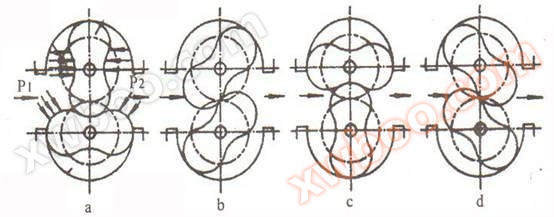
When the measured liquid flows through the measuring chamber, a pressure difference is formed at the inlet and outlet of the flowmeter, and the waist wheel rotates under the push of this pressure difference. Simultaneously, by fixing a pair of driving gears on the waist wheel shaft, the two waist wheels maintain continuous rotation. As the waist wheel rotates, the liquid is continuously discharged from the flow meter through the measuring chamber. The amount of liquid flowing through each pair is four times the volume of the measuring chamber. Through a sealed coupling and a reduction mechanism, the number of rotations is reduced and transmitted to a counter, which indicates the instantaneous flow rate and cumulative flow rate of the liquid. Installing a transmitter in the counter mechanism becomes a waist wheel flowmeter with a transmitter. Paired with display instruments or microcomputer systems, it can achieve remote (quantitative, cumulative, instantaneous, etc.) automated measurement and control.
Online inquiry
-
Contacts
-
Company
-
Telephone
-
Email
-
WeChat
-
Verification Code
-
Message Content
-